
$7
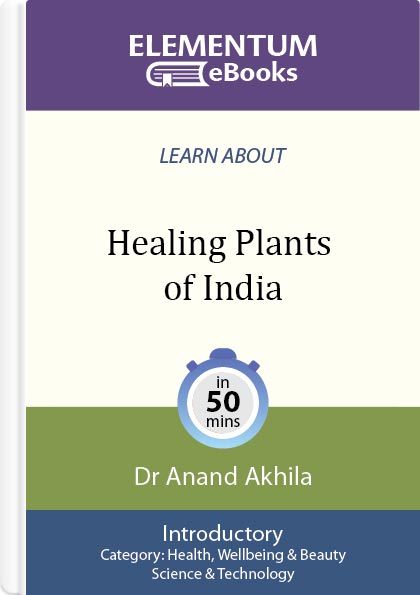
Learn About Healing Plants of India in 50 Minutes is a compact yet comprehensive introduction to 20 of India’s most important healing plants, written to give readers a solid grasp of both their Ayurvedic significance and their modern botanical and phytochemical profiles. It is organised plant-by-plant, with each chapter devoted to a single herb—such as Amla, Ashwagandha, Neem, Safed Musli, Shatavari, Tulsi, and Vacha—and follows a consistent structure so that readers can quickly compare and recall key points across herbs.
For every plant, the book presents its Sanskrit, botanical, and common names, plant family, and the main parts used, followed by a clear general overview that situates the herb within traditional Ayurvedic practice (for example, as a rasayana, blood purifier, brain tonic, or digestive aid). It then outlines major phytochemical groups and signature constituents (such as vitamin C and tannins in Amla, limonoids and azadirachtin in Neem, or saponins in Safed Musli), linking these to evidence-based therapeutic actions like antioxidant, adaptogenic, hepatoprotective, immunomodulatory, or neuroprotective effects.
Each chapter goes on to detail the herb’s medicinal and therapeutic properties in practical language—covering domains such as immunity, gut and liver health, cardiovascular support, skin and hair care, reproductive health, nervous system balance, cognition, and healthy ageing—so that readers can see exactly how and where a plant is traditionally used. The Ayurvedic perspective section summarises rasa (taste), guna (qualities), virya (potency), vipaka (post-digestive effect), effects on the doshas, and classical categories (e.g., medhya, rasayana, raktashodhak), giving both Ayurvedic students and interested lay readers an authentic doctrinal anchor.
Importantly, the book also highlights common preparations and routes of use—such as juices, powders, decoctions, pastes, oils, capsules, and household uses (eg, Neem twigs for dental care, Tulsi teas for colds, Vacha in minute doses for speech and cognition)—along with clear notes on precautions, dosage sensitivity, and situations where professional guidance is essential.
The work references contemporary research on key herbs like Neem, Tulsi, Shankhpushpi, and others, helping readers bridge classical Ayurvedic descriptions with modern pharmacology.
1. General Overview
• Sanskrit Name: Haridraa () or Haridra ()
• Scientific name: Curcuma longa
• Common names: Haldi, Turmeric, Haridra, Indian Saffron
• Family: Zingiberaceae (Ginger)
• Parts used: Rhizome (underground stem), dried and powdered
• Main bioactive compound: Curcumin, which gives turmeric its golden-yellow colour and healing power
2. Key Active Components (Phytochemistry)
Turmeric contains over 100 bioactive molecules, including:
• Curcumin – anti-inflammatory, antioxidant, anti-cancer, anti-microbial
• Demethoxycurcumin and Bisdemethoxycurcumin – antioxidant properties
• Turmerone and Atlantone – support liver and brain function
• Essential oils (zingiberene, a-phellandrene, sabinene) – antiseptic and aromatic
3. Medicinal and Therapeutic Properties
A. Anti-Inflammatory Powerhouse
• Curcumin inhibits inflammatory enzymes (COX-2, LOX, TNF-α)
• Used in arthritis, joint pain, swelling, and injuries
• Traditional remedy: Haldi doodh (turmeric milk) for body pain and inflammation
Dr Anand Akhila has an outstanding academic record, with first division and distinctions from high school through his M.Sc. in Chemistry, which he completed in 1976 at the University of Lucknow, India, standing first in order of merit. He received the prestigious National Scholarship of the Government of India to pursue a Ph.D. abroad and joined University College London in 1978, earning his Ph.D. from the University of London in 1980 under Dr D. V. Banthorpe.
During his Ph.D., he elucidated the biosynthetic pathways and mechanisms of key aroma compounds such as carvone, limonene, geraniol, carene, and pulegone at the molecular level in aromatic plants, pioneering work on isoprenoid biosynthesis and secondary metabolites. This research led to his appointment as Research Associate in 1981 and then Scientist in 1982 at the Central Institute of Medicinal and Aromatic Plants (CIMAP), a CSIR institute in Lucknow.
Over a 30-year research career on medicinal and aromatic plants, Dr Akhila worked extensively on species such as Artemisia annua (source of the antimalarial artemisinin), Mentha (for menthol production), and Neem (Azadirachta indica), earning the CSIR Young Scientist Award in Biological Sciences in 1988. His major contributions involve tracing biosynthetic pathways of high-value phytochemicals and supporting metabolic engineering approaches to increase yields of important medicinal and aroma constituents.
He established the biosynthesis of azadirachtin in Neem and presented an invited paper on this work at the World Neem Conference in Australia in 1996, along with studies on isolation, HPLC methods for key terpenoids, and synthesis of radiolabelled azadirachtin for ADME studies in insects and pests. His two Phytochemistry papers on artemisinin biosynthesis in Artemisia annua (1987, 1990) are considered pioneering and have been cited more than 90 times.
Dr Akhila has published over 60 research papers in reputed national and international journals, written several books, and delivered more than 25 presentations at symposia in countries such as Australia, Japan, and Singapore. He has also written on scientific and ethical issues in Current Science and served on the Executive Board of the Society for Scientific Values, New Delhi, for three years.
He is on the Editorial Board of the Journal of Plant Interactions and the Journal of Pharmaceutical and Biomedical Sciences, and has refereed for journals including Tetrahedron, Acta Physiologiae Plantarum, World Applied Science Journal, Biosciences Biotechnology Research Asia, Advances in Applied Science Research, and Journal of Biomedicine and Biotechnology. He is a member of several scientific societies, including the Royal Society of Chemistry, London.
Dr Anand Akhila has an outstanding academic record, with first division and distinctions from high school through his M.Sc. in Chemistry, which he completed in 1976 at the University of Lucknow, India, standing first in order of merit. He received the prestigious National Scholarship of the Government of India to pursue a Ph.D. abroad and joined University College London in 1978, earning his Ph.D. from the University of London in 1980 under Dr D. V. Banthorpe.
During his Ph.D., he elucidated the biosynthetic pathways and mechanisms of key aroma compounds such as carvone, limonene, geraniol, carene, and pulegone at the molecular level in aromatic plants, pioneering work on isoprenoid biosynthesis and secondary metabolites. This research led to his appointment as Research Associate in 1981 and then Scientist in 1982 at the Central Institute of Medicinal and Aromatic Plants (CIMAP), a CSIR institute in Lucknow.
Over a 30-year research career on medicinal and aromatic plants, Dr Akhila worked extensively on species such as Artemisia annua (source of the antimalarial artemisinin), Mentha (for menthol production), and Neem (Azadirachta indica), earning the CSIR Young Scientist Award in Biological Sciences in 1988. His major contributions involve tracing biosynthetic pathways of high-value phytochemicals and supporting metabolic engineering approaches to increase yields of important medicinal and aroma constituents.
He established the biosynthesis of azadirachtin in Neem and presented an invited paper on this work at the World Neem Conference in Australia in 1996, along with studies on isolation, HPLC methods for key terpenoids, and synthesis of radiolabelled azadirachtin for ADME studies in insects and pests. His two Phytochemistry papers on artemisinin biosynthesis in Artemisia annua (1987, 1990) are considered pioneering and have been cited more than 90 times.
Dr Akhila has published over 60 research papers in reputed national and international journals, written several books, and delivered more than 25 presentations at symposia in countries such as Australia, Japan, and Singapore. He has also written on scientific and ethical issues in Current Science and served on the Executive Board of the Society for Scientific Values, New Delhi, for three years.
He is on the Editorial Board of the Journal of Plant Interactions and the Journal of Pharmaceutical and Biomedical Sciences, and has refereed for journals including Tetrahedron, Acta Physiologiae Plantarum, World Applied Science Journal, Biosciences Biotechnology Research Asia, Advances in Applied Science Research, and Journal of Biomedicine and Biotechnology. He is a member of several scientific societies, including the Royal Society of Chemistry, London.