
$3
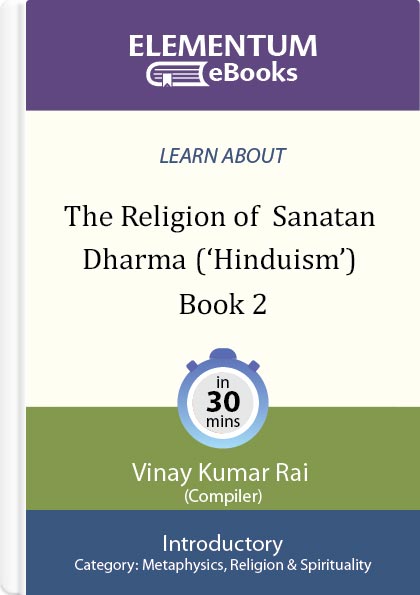
“Learn About the Religion of Sanatan Dharma (Hinduism) in 30 Minutes – Book 2” is a concise companion volume that focuses on the lived side of Sanatan Dharma: its deities, key terms, practices, festivals, and symbols.
The book is structured around Chapter 4 (“Major Deities, Terms, Practices”) and Chapter 5 (“Interesting Facts & Figures”), followed by sources and brief notes about the compiler and publisher. It introduces the main deities (Trimurti and prominent forms of Devi), then provides short, clear explanations of central Sanskrit concepts such as punarbhava, samsara, moksha, sadhana, sampradaya, shruti/smriti, tantra, and many more, written for intelligent beginners who want accurate meanings without heavy metaphysics.
The author emphasises that this is not a scholarly or theological deep dive but a systematic, matter-of-fact compilation of the clearest explanations from practitioners and experts, designed to be read in about half an hour. It aims to give readers a practical vocabulary and a panoramic feel for how Sanatan Dharma is actually understood and practised, complementing Book 1’s broader overview of origins, tenets, literature, and philosophies.
Number of Adherents: SD is the world’s third-largest religion, after Christianity and Islam. It is the faith of the vast majority of people in India, ie of over a billion people. Worldwide, there are over 1.1 billion Sanatanis, almost 14% of the global population.
Ultimate Goal: Recall that one of the defining features of SD is its belief in the cycle of reincarnation, in which the soul is repeatedly reborn into different bodies until it achieves moksha, or liberation from the cycle of death and rebirth. Sanatanis believe that the ultimate goal of life is to achieve moksha, and that the way to do this is through the practice of yoga and meditation, which helps to purify the mind and connect with the divine.
Direct Perception: In SD, every individual must realise the truth for herself or himself (pratyaksha anubhuti, direct perception of truth). You cannot achieve moksha by subscribing to a belief system, as in monotheism.
Record of Acceptance and Diversity: SD has a remarkable history of religious acceptance and inclusivity, as evidenced by historical records. India is the only land in the world in which Jews, the most persecuted minority in the world, have lived for 2,000 years without ever experiencing anti-Semitism. The same can be said for Zoroastrians, Greeks, Huns, Christians, Mongols, and Muslims: They have been given refuge and provided complete religious freedom and protection. The cave temples and monasteries of Ellora—SD, Jain, and Buddhist temples and monasteries—were carved into a mountain beside each other more than 1,000 years ago, a shining example of religious harmony within Indic traditions. Not a single verse in any text of SD looks down on, condemns, or incites violence against another religion, culture, or race.
Vinay Kumar Rai is an editor (he polishes someone else’s writing); a self-publishing consultant (he tells authors-to-be how to self-publish their books); a copywriter (he writes marketing copy for blog posts, brochures, DMs and eDMs, flyers, profiles, sales letters, Websites, etc); a writer (he writes educational articles for magazines and Websites); and a ghostwriter (he writes books for other people).
He’s been writing professionally since 2001 and for fun since he was six years of age, the latter being more than half a century ago.
His strength is in communicating difficult ideas and jargon. His clients are typically experts, publishers, or business people with products or services to market.
He has no wives, no kids, no pets, and no Pokémon. However, he does have a lot of books.
He’s really into Karma, the Golden Rule, first principles, mental models, universal laws, and philosophy.
He’s not a fan of the “My God true, your God false” types but he is a big fan of Alan Watts, Béchamp, Buckminster Fuller, Frederick Winslow Taylor, Friedrich Nietzsche, Giordano Bruno, Jiddu Krishnamurti, Nikola Tesla, Norman Borlaug, Oskar Schindler, Raoul Wallenberg, Rudolf Steiner, Socrates, Viktor Schauberger, and Swami
Vivekananda.
Vinay is the founder of Elementum.
Vinay Kumar Rai is an editor (he polishes someone else’s writing); a self-publishing consultant (he tells authors-to-be how to self-publish their books); a copywriter (he writes marketing copy for blog posts, brochures, DMs and eDMs, flyers, profiles, sales letters, Websites, etc); a writer (he writes educational articles for magazines and Websites); and a ghostwriter (he writes books for other people).
He’s been writing professionally since 2001 and for fun since he was six years of age, the latter being more than half a century ago.
His strength is in communicating difficult ideas and jargon. His clients are typically experts, publishers, or business people with products or services to market.
He has no wives, no kids, no pets, and no Pokémon. However, he does have a lot of books.
He’s really into Karma, the Golden Rule, first principles, mental models, universal laws, and philosophy.
He’s not a fan of the “My God true, your God false” types but he is a big fan of Alan Watts, Béchamp, Buckminster Fuller, Frederick Winslow Taylor, Friedrich Nietzsche, Giordano Bruno, Jiddu Krishnamurti, Nikola Tesla, Norman Borlaug, Oskar Schindler, Raoul Wallenberg, Rudolf Steiner, Socrates, Viktor Schauberger, and Swami
Vivekananda.
Vinay is the founder of Elementum.